The Commutative Property Trick: How to Learn Half the Multiplication Tables
Discover how understanding that 7×8 equals 8×7 can cut your child's memorization workload nearly in half.
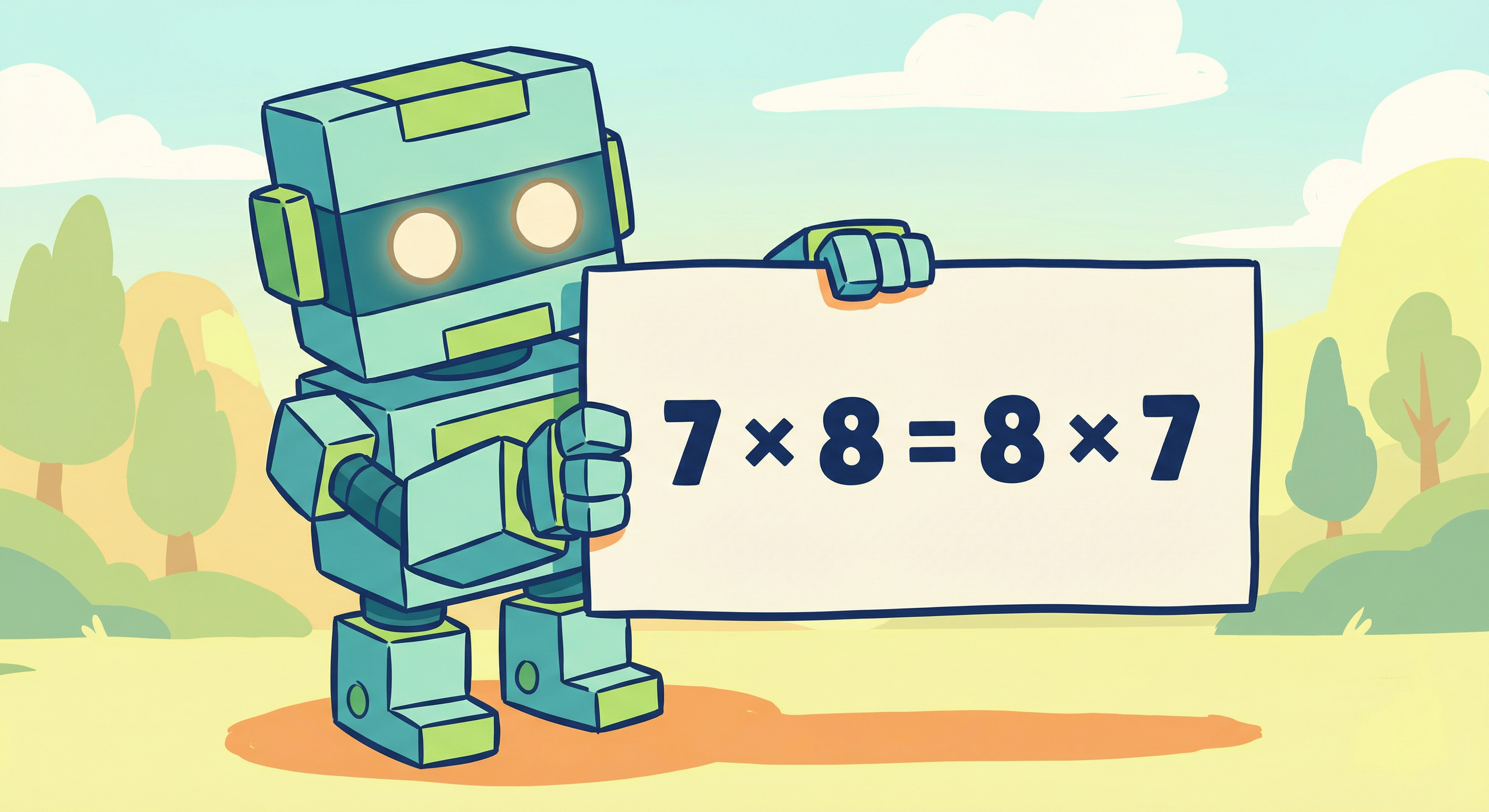
What if I told you there's a simple math concept that can cut the number of multiplication facts your child needs to memorize nearly in half? It's called the commutative property, and it's one of the most powerful tools for efficient times table learning.
What is the Commutative Property?
The commutative property of multiplication states that the order of factors doesn't change the product:
3 × 4 = 4 × 3
Both equal 12. You can think of it as:
- 3 groups of 4 (●●●● ●●●● ●●●●) = 12
- 4 groups of 3 (●●● ●●● ●●● ●●●) = 12
Same total, just arranged differently.
Why This Matters for Learning
Let's count the facts in a standard 12×12 multiplication table:
Without using the commutative property:
- Facts from 1×1 to 12×12
- That's 144 facts to learn
- (Actually even more if you include 0s)
Using the commutative property:
- Once you know 7×8, you automatically know 8×7
- Once you know 3×9, you automatically know 9×3
- This nearly cuts your workload in half!
Here's the actual breakdown:
- 12 facts where both numbers are the same (2×2, 3×3, etc.)-no commutative partner
- 66 pairs of facts that are commutative partners (like 3×7 and 7×3)
- Total unique facts: 12 + 66 = 78 facts instead of 144
That's a 46% reduction in memorization work!
The Multiplication Table Triangle
A great way to visualize this is with a triangle approach. Look at a multiplication table:
    1   2   3   4   5   6<br/>
1   1   2   3   4   5   6<br/>
2   2   4   6   8  10  12<br/>
3   3   6   9  12  15  18<br/>
4   4   8  12  16  20  24<br/>
5   5  10  15  20  25  30<br/>
6   6  12  18  24  30  36<br/>
```<br/>
<br/>
Notice that the table is symmetrical along the diagonal (1, 4, 9, 16, 25, 36). Everything above the diagonal mirrors what's below it.<br/>
<br/>
**You only need to learn the diagonal and one side of the triangle!**<br/>
<br/>
## Teaching Children the Commutative Property<br/>
<br/>
### For Young Children (Visual/Physical)<br/>
<br/>
Use arrays of objects to show that rearranging doesn't change the total:<br/>
<br/>
"Here are 3 rows of 4 cookies. Let's count: 12 cookies."<br/>
"Now let's rearrange them into 4 rows of 3. Count again: still 12 cookies!"<br/>
"See? 3 times 4 and 4 times 3 give us the same answer!"<br/>
<br/>
Use:<br/>
- Building blocks in rows and columns<br/>
- Stickers arranged on paper<br/>
- Egg cartons with small objects<br/>
- Graph paper coloring<br/>
<br/>
### For Older Children (Logical)<br/>
<br/>
Explain the reasoning:<br/>
"If you have 3 bags with 4 apples each, that's 12 apples total."<br/>
"If you reorganize into 4 bags with 3 apples each, you still have 12 apples."<br/>
"You didn't add or remove any apples, just moved them around."<br/>
<br/>
Then connect to their learning:<br/>
"This means when you learn that 7×8=56, you automatically know 8×7=56 too!"<br/>
<br/>
## Strategic Learning Order<br/>
<br/>
Use the commutative property to learn facts in the most efficient order:<br/>
<br/>
### Phase 1: The Easy Facts<br/>
Start with facts that are easy AND give you their commutative partner:<br/>
<br/>
- **×1 facts**: 1×2, 1×3... through 1×12 (now you also know 2×1, 3×1, etc.)<br/>
- **×10 facts**: 10×2, 10×3... (easy patterns, doubles your knowledge)<br/>
- **×2 facts**: Doubles-2×3, 2×4... (relatively easy)<br/>
- **×5 facts**: 5×3, 5×4... (predictable pattern)<br/>
<br/>
### Phase 2: The Perfect Squares<br/>
Learn the diagonal facts that don't have commutative partners:<br/>
- 3×3=9, 4×4=16, 6×6=36, 7×7=49, 8×8=64, 9×9=81, 11×11=121, 12×12=144<br/>
<br/>
### Phase 3: The Remaining Facts<br/>
Now you're left with just the "tough facts":<br/>
- 6×7, 6×8, 6×9, 6×11, 6×12<br/>
- 7×8, 7×9, 7×11, 7×12<br/>
- 8×9, 8×11, 8×12<br/>
- 9×11, 9×12<br/>
- 11×12<br/>
<br/>
That's only 15 fact pairs (30 facts with their partners) that require serious memorization effort!<br/>
<br/>
## Reinforcing the Connection<br/>
<br/>
During practice, regularly reinforce that pairs are connected:<br/>
<br/>
**When you ask 6×7:**<br/>
- Child answers: 42<br/>
- Follow up: "And what's 7×6?"<br/>
- Child: 42<br/>
- You: "Right! They're always the same!"<br/>
<br/>
**Present problems in pairs:**<br/>
- Flash 6×7 then immediately 7×6<br/>
- Let the child see that knowing one means knowing both<br/>
<br/>
**Celebrate the efficiency:**<br/>
- "You just learned TWO facts with one piece of information!"<br/>
- "See how smart it is to use what you already know?"<br/>
<br/>
## Common Mistakes to Avoid<br/>
<br/>
### Mistake 1: Teaching All Facts as Separate Items<br/>
Some approaches drill each fact independently, missing the power of commutative pairs. Always connect paired facts explicitly.<br/>
<br/>
### Mistake 2: Only Using One Order<br/>
If you only ever ask "7×8," your child might hesitate when they see "8×7" on a test. Practice both orders randomly.<br/>
<br/>
### Mistake 3: Forgetting Square Numbers<br/>
The diagonal facts (4×4, 7×7, etc.) don't have partners, so they need extra attention. Don't let them fall through the cracks.<br/>
<br/>
## Beyond Memorization: Understanding Why<br/>
<br/>
For curious children, you can explain why the commutative property works:<br/>
<br/>
"Multiplication is just a faster way of adding equal groups. And when you're adding up the total, it doesn't matter what order you add things. 4+4+4 is the same as counting by 4s three times OR counting by 3s four times. Either way, you get to 12."<br/>
<br/>
This deeper understanding helps facts stick and builds mathematical reasoning.<br/>
<br/>
## Making It Stick<br/>
<br/>
Use these strategies to reinforce the commutative property:<br/>
<br/>
1. **Array drawings**: Have children draw rectangles and label both dimensions<br/>
2. **Commutative partner flashcards**: One card, both facts written on it<br/>
3. **Verbal reminders**: "Remember, you already know this one from knowing its partner"<br/>
4. **Practice both ways**: Randomly mix 6×8 and 8×6 in practice sessions<br/>
5. **Connect to other operations**: Later, show that addition is also commutative (3+5=5+3)<br/>
<br/>
## The Payoff<br/>
<br/>
Children who understand and use the commutative property:<br/>
- Learn their times tables faster<br/>
- Feel less overwhelmed by the task<br/>
- Develop mathematical reasoning skills<br/>
- Build confidence in their math abilities<br/>
- Have strategies for figuring out unknown facts<br/>
<br/>
Best of all, they're learning to work smarter, not just harder-a valuable lesson that extends far beyond multiplication.<br/>