Multiplication in Real Life: Showing Kids Why It Matters
"When will I ever use this?" It's a question every parent dreads, and multiplication often triggers it. Children can sense when learning feels disconnected from their lives. The good news is that multiplication is everywhere-we just need to help children see it.
Why Real-Life Connections Matter
When children understand why something matters, they're more motivated to learn it. Abstract facts (7×8=56) become meaningful when connected to real situations (figuring out how many trading cards are in 7 packs of 8).
Research shows that learning in context:
- Improves retention and recall
- Increases motivation and engagement
- Helps children apply knowledge flexibly
- Reduces the "when will I use this" complaint
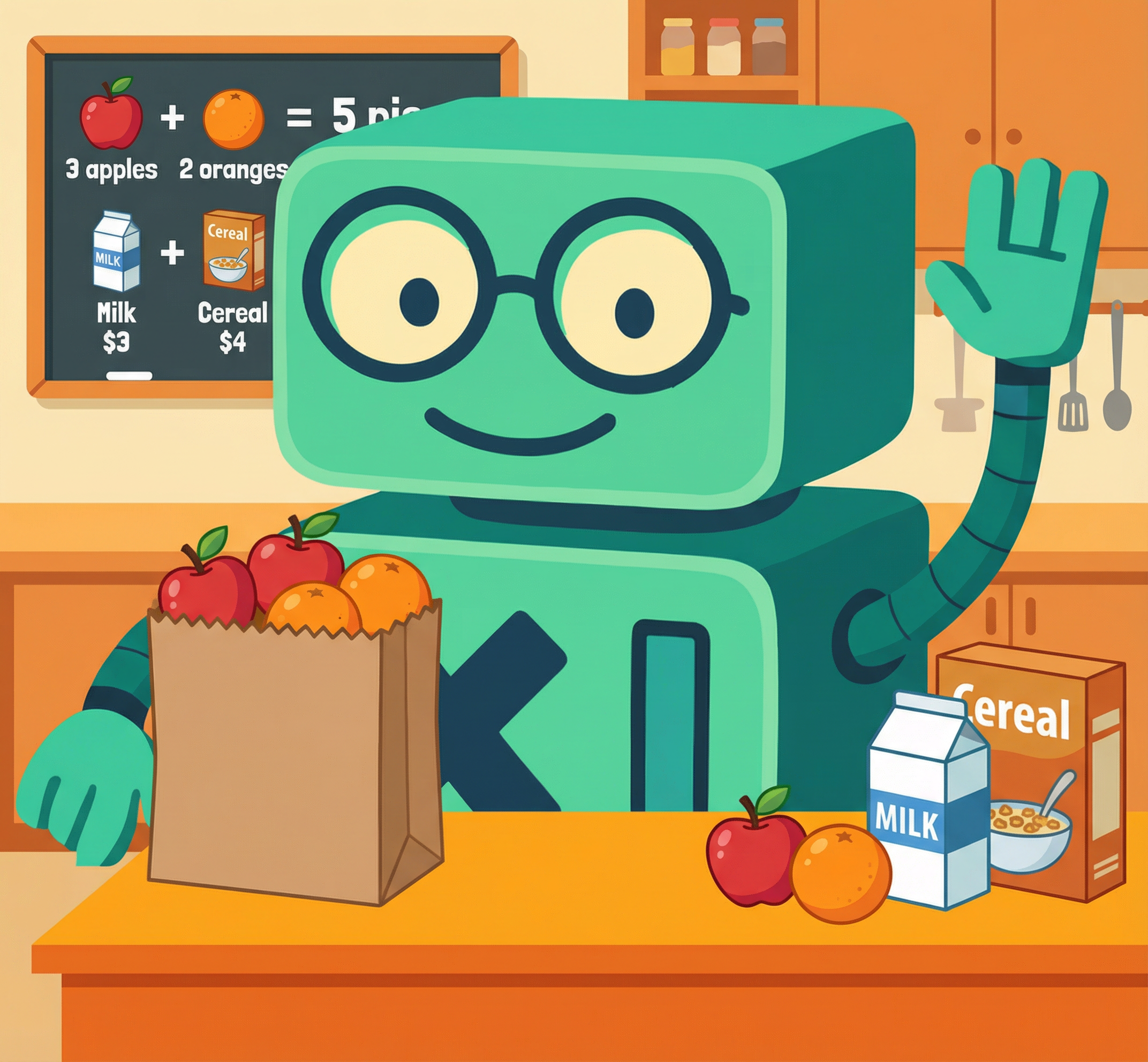
At the Grocery Store
The supermarket is a multiplication classroom waiting to happen:
Calculating totals:
- "These yogurts come in packs of 6. If we buy 3 packs, how many yogurts is that?"
- "Apples are $2 each. How much for 5 apples?"
Comparing values:
- "This box has 8 granola bars for $4. That box has 12 bars for $5. Which is the better deal?"
- "The small juice is 4 servings. The large is 3 times as much. How many servings?"
Counting items:
- "The egg carton has 2 rows of 6. How many eggs?"
- "Count the water bottles in the pack-3 rows of 4."
Tip: Let your child use a calculator to check their mental math. The goal is understanding multiplication's usefulness, not creating pressure.
In the Kitchen
Cooking and baking offer natural multiplication practice:
Scaling recipes:
- "This recipe serves 4 people, but we need to serve 8. How many cups of flour do we need if the recipe calls for 2?"
- "We're making half the recipe. If it calls for 6 eggs, how many do we need?"
Measuring portions:
- "Each person gets 3 meatballs. How many do we need for 5 people?"
- "If everyone eats 2 slices of pizza and there are 6 of us, how many slices total?"
Time calculations:
- "The cookies bake for 12 minutes. If we're making 4 batches, how long will baking take?"
Setting the table:
- "How many pieces of silverware do we need for 6 people if each person gets a fork, knife, and spoon?"
In Sports and Games
Children often care deeply about sports statistics and game mechanics:
Sports math:
- "If a basketball player scores 8 points per game, how many points in a 5-game week?"
- "A soccer team played 9 games and scored 3 goals per game. How many total goals?"
- "In football, a touchdown is worth 6 points. How much for 4 touchdowns?"
Game scores:
- "In this video game, each coin is worth 5 points. You collected 12 coins. What's your score?"
- "You need 100 gems to buy that item. If each level gives you 8 gems, how many levels do you need to complete?"
Card and board games:
- "You have 7 cards worth 4 points each. What's your score?"
- "In Monopoly, the rent is $8. If 3 people land on your property, how much do you collect?"
While Traveling
Car trips, walks, and waiting rooms offer multiplication opportunities:
Time and distance:
- "If we drive 60 miles per hour for 3 hours, how far will we go?"
- "The train comes every 15 minutes. How many times does it come in an hour?"
Counting games:
- "I see a parking lot with 4 rows of 8 cars. How many cars?"
- "That apartment building has 5 floors with 6 windows each. How many windows?"
Planning:
- "If we visit 3 museums and spend 2 hours at each, how many hours of museum time?"
- "The hotel costs $150 per night. How much for 4 nights?"
With Money
Financial literacy and multiplication go hand in hand:
Earning and saving:
- "If you save $5 per week, how much will you have after 8 weeks?"
- "You earn $3 for each chore. How much if you do 4 chores?"
Spending decisions:
- "These toys cost $7 each. Can you buy 3 with your $20?"
- "The game costs $24. If you save $4 per week, how many weeks until you can buy it?"
Counting coins:
- "You have 6 quarters. How many cents is that?"
- "Count these nickels by 5s. Now count these dimes by 10s."
At Home
Everyday household situations involve multiplication:
Organization:
- "We need to organize 36 books on shelves. If each shelf holds 6 books, how many shelves do we need?"
- "The egg carton holds 12 eggs in 2 rows. How many in each row?"
Sharing:
- "We have 24 strawberries for 4 people. How many does each person get?"
- "How can we split these 15 stickers fairly among 3 friends?"
Time:
- "You practice piano for 20 minutes each day. How many minutes per week?"
- "There are 7 days in a week. How many days in 4 weeks?"
Making It Natural, Not Forced
The key is to integrate multiplication questions naturally rather than turning every moment into a quiz:
Do:
- Wonder aloud: "Hmm, I'm trying to figure out how many bottles we need..."
- Ask for help: "Can you help me calculate this?"
- Make it a game: "I bet you can't figure this out before we reach the next light..."
- Be genuinely curious: "I wonder how many tiles are on this floor..."
Don't:
- Turn every outing into a math test
- Create pressure or frustration
- Interrupt fun activities too often
- Make children feel like they're being quizzed constantly
When Children Ask "Why?"
Sometimes the direct answer is best:
"You'll use multiplication for:
- Managing money as a grown-up
- Understanding deals and discounts
- Doing your job (almost every job uses math)
- Cooking for your family someday
- Building things and doing projects
- Understanding news and statistics
- Making smart decisions with numbers"
And honestly:
"Even if you don't multiply every day as an adult, learning multiplication builds your brain. It makes you better at thinking logically and solving all kinds of problems."
The Bigger Picture
Connecting multiplication to real life isn't just about motivation-it's about building true mathematical understanding. Children who see multiplication in action understand it more deeply than those who only see it as abstract facts on a page.
Every time you point out multiplication in the real world, you're showing your child that math isn't just a school subject. It's a tool for understanding and navigating life. That understanding lasts far longer than memorized facts alone.