The Science of Spaced Repetition: Why Daily Practice Beats Weekend Cramming
If you've ever crammed for an exam, you know the frustrating experience of forgetting everything within days. Yet when it comes to helping our children learn multiplication tables, many of us fall into the same trap-marathon study sessions followed by long breaks. Science tells us there's a much better way.
The Forgetting Curve: Why We Forget
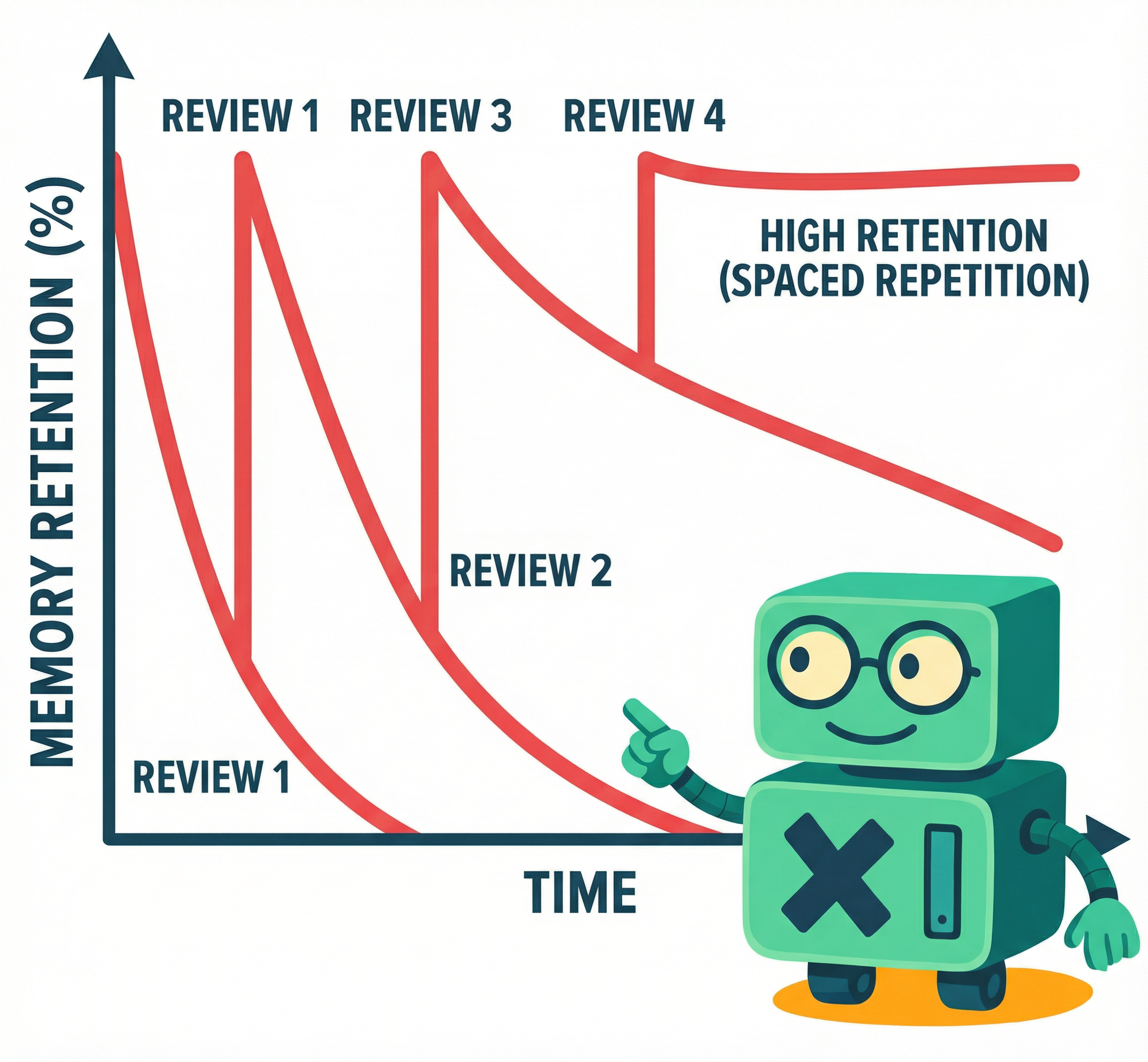
In 1885, German psychologist Hermann Ebbinghaus discovered something remarkable about human memory. He found that we forget information in a predictable pattern-rapidly at first, then more gradually over time. This is called the "forgetting curve."
Here's the surprising part: we forget approximately 70% of new information within 24 hours if we don't review it. After a week, that number climbs even higher.
But Ebbinghaus also discovered the solution: each time we review information at the right moment, the forgetting curve flattens. The memory becomes more durable.
What is Spaced Repetition?
Spaced repetition is a learning technique that uses increasing intervals between review sessions. Instead of studying the same material repeatedly in one sitting, you spread practice over days and weeks.
The principle is simple:
- Review new information soon after learning it
- Gradually increase the time between reviews
- Focus more on items you find difficult
- Spend less time on items you already know well
Why It Works So Well for Multiplication
Multiplication tables are perfect for spaced repetition because:
- They're discrete facts-each multiplication problem is a separate item to learn
- They need to become automatic-you want instant recall, not calculation
- They're interconnected-knowing 6×7 helps with 7×6, 12×7, and division
- They have clear right/wrong answers-easy to track progress
The 5-Minute Daily Advantage
Consider two approaches to learning multiplication:
Approach A (Weekend Cramming)
- Saturday: 45 minutes of intensive practice
- Sunday: 45 minutes of intensive practice
- Monday-Friday: No practice
- Total weekly time: 90 minutes
Approach B (Daily Practice)
- Every day: 10 minutes of practice
- Total weekly time: 70 minutes
Research consistently shows that Approach B produces dramatically better results, even though it takes less total time. The child using daily practice will:
- Remember more facts accurately
- Retain knowledge longer
- Experience less frustration
- Build a sustainable habit
A Practical Spaced Repetition Schedule
Here's a realistic schedule for learning multiplication tables:
Week 1-2: The 2s, 5s, and 10s
- Day 1: Learn 2× facts (10 minutes)
- Day 2: Review 2×, introduce 5× (10 minutes)
- Day 3: Review 2× and 5×, introduce 10× (10 minutes)
- Days 4-7: Mixed review of all three (10 minutes each)
Week 3-4: The 3s and 4s
- Follow the same pattern, while mixing in previous facts
Week 5-6: The 6s and 7s
- These are typically harder-spend more time here
Week 7-8: The 8s and 9s
- Include tricks like the 9s finger method
Week 9+: Mixed review and mastery
- Focus on weak spots identified through practice
Signs of Effective Spacing
How do you know if spaced repetition is working? Look for:
- Quick recall of facts learned weeks ago
- Consistent performance rather than good days and bad days
- Reduced anxiety during practice sessions
- Genuine confidence when approaching new multiplication problems
Technology and Spaced Repetition
Modern apps like Numpli use spaced repetition algorithms to automatically optimize review schedules. The app tracks which facts your child knows well and which need more practice, then adjusts accordingly.
This takes the guesswork out of scheduling and ensures that practice time is used efficiently. Facts that are well-known appear less frequently, while challenging facts appear more often-exactly what the science recommends.
Making It Stick
The key insight from spaced repetition research is counterintuitive: a little forgetting is actually helpful. When we successfully recall something we were about to forget, that memory becomes stronger than if we'd reviewed it too soon.
This is why daily practice works better than cramming. Each session involves just enough challenge to strengthen memories without overwhelming the child.
Start Today
You don't need special materials to begin using spaced repetition. Just commit to:
- Short daily practice (5-10 minutes)
- Mixing old facts with new ones
- Giving extra attention to difficult facts
- Being patient-true mastery takes weeks, not days
The science is clear: consistent, spaced practice is the most effective path to multiplication mastery. The only question is when to start.