The Trachtenberg System: Fast Mental Multiplication
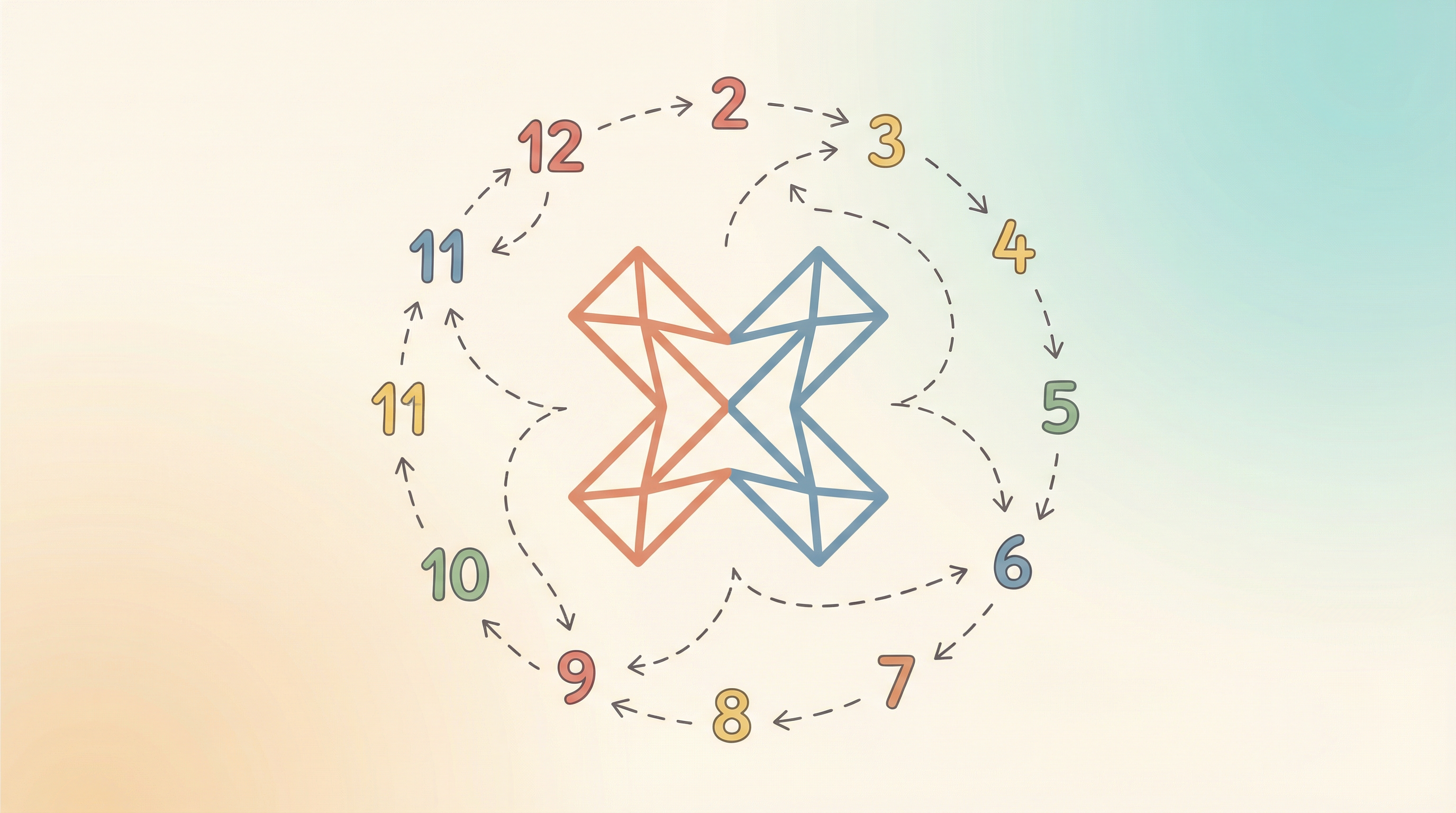
The Trachtenberg system is a method of fast mental calculation created by Ukrainian‑Jewish mathematician Jakow Trachtenberg while he was imprisoned in a Nazi concentration camp. With a handful of rules, you can mentally multiply numbers by 2, 3, 4… up to 12—without writing anything down or using a calculator. It’s fun as a “magic trick”, but even more valuable as a way to feel numbers more deeply and support multiplication learning.
Basic ideas
Before looking at the rules, let’s fix three ideas:
- Neighbor – the digit immediately to the right of the current digit. If there is no digit to the right, the neighbor is 0.
- Leading zero – for every number we work with, we imagine a zero in front (for example, 3461 becomes 03461).
- Half of a digit – always half rounded down to a whole number: half of 9 is 4, half of 1 is 0, half of 0 is 0.
Multiplying by 12
Take the number 7117 (written as 07117):
- Double each digit and add its neighbor.
- If the result is ≥ 10, keep only the ones digit and carry the tens digit “down” to the next step.
Example: 7117 × 12. Work from right to left:
7 → 7×2 + 0 = 14 → 4, carry 1 | 1 → 1×2 + 7 + 1 = 10 → 0, carry 1 | 1 → 1×2 + 1 + 1 = 4 | 7 → 7×2 + 1 = 15 → 5, carry 1 | 0 → 0×2 + 7 + 1 = 8.
Reading from the bottom: 85404.
Multiplying by 11
For 2345 (02345):
- To each digit, add its neighbor.
- If the result is ≥ 10, keep the ones digit and carry the tens.
Example: 2345 × 11. From the right:
5 + 0 = 5 | 4 + 5 = 9 | 3 + 4 = 7 | 2 + 3 = 5 | 0 + 2 = 2.
Result: 25795.
Multiplying by 9
For 34567 (034567):
- Rightmost digit: subtract it from 10.
- All others: subtract the digit from 9, then add the neighbor and any carry.
Example: 34567 × 9. From the right:
7 → 10−7 = 3 | 6 → (9−6)+7 = 10 → 0, carry 1 | 5 → (9−5)+6+1 = 11 → 1, carry 1 | 4 → (9−4)+5+1 = 11 → 1, carry 1 | 3 → (9−3)+4+1 = 11 → 1, carry 1 | 0 → (9−0)+3+1 = 13 (we write 3).
Result: 311103.
Multiplying by 8
Very similar to ×9, but:
- Rightmost digit: (10 − digit) × 2.
- Others: (9 − digit) × 2 + neighbor (+ carry).
Example: 45678 × 8. From the right (045678):
8 → (10−8)×2 = 4 | 7 → (9−7)×2+8 = 12 → 2, carry 1 | 6 → (9−6)×2+7+1 = 14 → 4, carry 1 | 5 → (9−5)×2+6+1 = 15 → 5, carry 1 | 4 → (9−4)×2+5+1 = 16 → 6, carry 1 | 0 → (9−0)×2+4+1 = 23 (we write 3).
Result: 365424.
Multiplying by 7
- Double the digit and add half the neighbor.
If the digit is odd, add 5. - Carry tens as usual.
Example: 56789 × 7. From the right (056789): half of 0 is 0; 9 is odd → +5.
9 → 9×2+0+5 = 23 → 3, carry 2 | 8 → 8×2+4+2 = 22 → 2, carry 2 | 7 → 7×2+4+5+2 = 25 → 5, carry 2 | 6 → 6×2+3+2 = 17 → 7, carry 1 | 5 → 5×2+3+5+1 = 19 → 9, carry 1 | 0 → 0×2+2+1 = 3.
Result: 397523.
Multiplying by 6
- To each digit, add half its neighbor.
If the digit is odd, add 5.
Example: 67890 × 6. From the right (067890): half of 0 is 0; 9 and 7 are odd → +5.
0 → 0+0 = 0 | 9 → 9+0+5 = 14 → 4, carry 1 | 8 → 8+4+1 = 13 → 3, carry 1 | 7 → 7+4+5+1 = 17 → 7, carry 1 | 6 → 6+3+1 = 10 → 0, carry 1 | 0 → 0+3+1 = 4.
Result: 407340.
Multiplying by 5
- For each position, take half the neighbor.
If the digit is odd, add 5.
Example: 91372 × 5. From the right (091372): 2, 7, 3, 1, 9 are odd → +5.
2 → half 0 = 0 | 7 → half 1 + 5 = 6 | 3 → half 3 + 5 = 8 | 1 → half 1 + 5 = 6 | 9 → half 0 + 5 = 5 | 0 → half 4 = 4.
Result: 456860.
Multiplying by 4 and 3
For 4:
Rightmost digit: subtract it from 10 (+5 if it’s odd).
Others: (9 − digit) + half neighbor (+5 if the digit is odd).
For 3: same pattern, but (10 − digit) and (9 − digit) are first multiplied by 2, then you add half the neighbor and 5 if the digit is odd.
Example ×4: 8621 × 4 (08621). From the right:
1 → (10−1)+0+5 = 14 → 4, carry 1 | 2 → (9−2)+0+1 = 8 | 6 → (9−6)+1 = 4 | 8 → (9−8)+3 = 4 | 0 → (9−0)+4 = 13 (3).
Result: 34484.
Example ×3: 5083 × 3 (05083). From the right:
3 → (10−3)×2+0+5 = 19 → 9, carry 1 | 8 → (9−8)×2+1+1 = 4 | 0 → (9−0)×2+4 = 22 → 2, carry 2 | 5 → (9−5)×2+0+5+2 = 15 → 5, carry 1 | 0 → (9−0)×2+2+1 = 21 (1).
Result: 15249.
Multiplying by 2
- Simply double each digit and carry tens.
Example: 9870 × 2 (09870). From the right:
0 → 0×2 = 0 | 7 → 7×2 = 14 → 4, carry 1 | 8 → 8×2+1 = 17 → 7, carry 1 | 9 → 9×2+1 = 19 → 9, carry 1 | 0 → 0×2+1 = 1.
Result: 19740.
Why this helps with multiplication tables
The Trachtenberg system doesn’t replace the multiplication table, but it supports understanding:
- It shows that you can reach the answer step by step, without blind memorization.
- It trains working with digits and carries—the same logic as written multiplication, but in your head.
- It gives children (and adults) the feeling “I can work this out myself”, which boosts confidence in math.
You can treat it as an extra tool: first, build a solid foundation with the usual tables (for example, in Numpli), then—if your child is curious—explore how Trachtenberg multiplied in his head.
Summary
The Trachtenberg system is a collection of simple rules for multiplying by 2–12 in your head, with no paper or calculator. It’s worth knowing for extra fluency and a better “feel” for numbers. For more background and examples, see e.g. Trachtenberg system on Wikipedia.
---
Numpli helps children master multiplication tables step by step. Get the app and practise with us.